# 使用 AgentScope-Tuner 训练邮件搜索智能体
本示例展示如何使用 AgentScope-Tuner 对邮件搜索任务(灵感来自 [ART](https://openpipe.ai/blog/art-e-mail-agent))进行强化微调,其 RFT 功能由 [Trinity-RFT](https://github.com/agentscope-ai/Trinity-RFT) 提供支持。
## 任务设定
智能体的目标是通过搜索邮件收件箱来回答用户查询。智能体需要:
- 理解用户的问题
- 使用关键词搜索相关邮件
- 阅读邮件内容以提取信息
- 提供准确的答案并附上适当的来源引用
**智能体类型**:智能体(`EmailSearchAgent`)继承自 `ReActAgent`,遵循推理-行动循环来迭代解决任务。
**环境**:环境是一个包含来自 Enron 邮件数据集的 SQLite 数据库。每个任务提供:
- `question`:用户的邮件搜索查询
- `inbox_address`:要搜索的邮件收件箱
- `query_date`:查询的日期上下文
- `answer`:预期答案(真实值),仅用于奖励计算
- `message_ids`:包含答案的相关邮件 ID,仅用于奖励计算
**可用工具**:
- `search_emails`:通过关键词、收件箱地址和日期范围查找邮件。返回邮件摘要列表(message_id 和片段)。
- `read_email`:通过 message_id 读取特定邮件的完整内容。
- `generate_response`:提供带有来源的最终结构化答案(继承自 ReAct 智能体)。
## 数据集准备
数据集包含基于 [Enron 邮件数据集](https://huggingface.co/datasets/corbt/enron-emails) 的邮件查询。运行数据准备脚本以生成邮件数据库和数据集:
```bash
python prepare_data.py
```
如果你想选择新的数据库路径,可以修改 [`prepare_data.py`](./prepare_data.py) 中的 `DEFAULT_DB_PATH`。同时,请记住在进入下一步之前设置环境变量 `DEFAULT_EMAIL_DB_PATH` 指向数据库路径:
```bash
export DEFAULT_EMAIL_DB_PATH=/path/to/enron_emails_dataset/data/enron_emails.db
```
这将创建一个 SQLite 数据库和数据集:
```
/path/to/enron_emails_dataset/
├── data
└── enron_emails.db # 邮件数据库
├── train.parquet # 训练样本
└── test.parquet # 测试样本
```
每个样本如下所示:
```json
{
"id": 0,
"question": "Were there any variances detected for hour 6 on 3/9/01?",
"answer": "Yes, variances were detected in both Generation and Energy Import/Export schedules for hour 6 on 3/9/01.",
"message_ids": ["<17407857.1075840601283.JavaMail.evans@thyme>"],
"how_realistic": 0.800000011920929,
"inbox_address": "pete.davis@enron.com",
"query_date": "2001-03-16"
}
```
## 代码实现
本节提供代码实现的高级概览。详细实现请参考源代码。
### 智能体工作流
工作流函数 `run_email_search_agent` 实现智能体-环境交互循环:
```python
async def run_email_search_agent(
task: Dict,
model: ChatModelBase,
auxiliary_models: Dict[str, ChatModelBase],
) -> WorkflowOutput:
# 解析任务并创建智能体
agent = EmailSearchAgent(
name="email_search_agent",
sys_prompt=system_prompt,
model=model,
max_iters=max_turns,
)
# 使用结构化输出运行智能体
response = await agent.reply(
msg=Msg("user", question, role="user"),
structured_model=AnswerModel,
)
return WorkflowOutput(response=response)
```
智能体遵循 ReAct 模式:它推理任务,调用工具搜索和阅读邮件,最后生成包含答案和来源消息 ID 的结构化响应。
### 评判函数
评判函数 `email_search_judge` 使用 LLM-as-a-Judge 实现奖励计算:
```python
async def email_search_judge(
task: Dict,
response: Msg,
auxiliary_models: Dict[str, ChatModelBase],
) -> JudgeOutput:
# 从响应中提取答案和来源
answer = answer_and_sources.get("answer")
sources = answer_and_sources.get("sources", [])
# 使用 LLM-as-a-Judge 评判正确性
judge_model = auxiliary_models.get('judge') or list(auxiliary_models.values())[0]
judge_response = await judge_correctness(
answer, query, judge_model
)
# 基于以下因素计算奖励:
# - 答案正确性(准确度:-1.0 到 1.0)
# - 来源正确性(格式:部分奖励)
# - 效率(对更少轮次、正确来源的奖励)
result = {"accuracy": ..., "format": ...} # 基于 judge_response 计算
return JudgeOutput(
reward=sum(result.values()),
metrics=metrics,
)
```
奖励函数考虑以下因素:
- **答案正确性**:通过 LLM-as-a-Judge 比较智能体的答案与真实值进行评估
- **来源正确性**:智能体是否引用了正确的邮件消息 ID
- **效率**:对找到/阅读正确邮件和更少轮次的奖励
详细实现请参考 [`main.py`](./main.py) 和 [`email_search_agent.py`](./email_search_agent.py)。
## 运行方法
### 前置要求
- 至少 4 张 NVIDIA GPU,CUDA 版本 ≥ 12.8
* 注意:对于 30B 评判模型,需要使用至少 4080 显存的 GPU;你也可以通过使用 `tensor_parallel_size > 1` 在多张 GPU 上运行模型以减少显存使用(默认情况下,`tensor_parallel_size=2`)。
- 按照 Trinity-RFT [安装指南](https://agentscope-ai.github.io/Trinity-RFT/zh/main/tutorial/trinity_installation.html) 从源码安装最新版本
- 下载模型检查点(示例):
```bash
huggingface-cli download Qwen/Qwen3-4B-Instruct-2507
huggingface-cli download Qwen/Qwen3-30B-A3B-Instruct-2507 # 评判模型
```
### 配置
根据你的硬件调整配置文件([`config.yaml`](./config.yaml))。关键配置部分包括:
- **TunerModelConfig**:将 `model_path` 设置为你的模型检查点路径
- **AlgorithmConfig**:配置 RL 算法参数(例如,`multi_step_grpo`、学习率、策略损失函数)
- **DatasetConfig**:数据集路径在创建 `DatasetConfig` 对象时在 `main.py` 中指定
- **辅助模型**:为 LLM-as-a-Judge 配置评判模型设置
完整配置详情请参考 [Trinity-RFT 配置指南](https://agentscope-ai.github.io/Trinity-RFT/zh/main/tutorial/trinity_configs.html)。
### 启动命令
1. 准备数据集:
```bash
python prepare_data.py
export DEFAULT_EMAIL_DB_PATH=/path/to/enron_emails_dataset/data/enron_emails.db
```
2. 启动 [Ray](https://github.com/ray-project/ray):
```bash
ray start --head
```
3. 运行训练脚本:
```bash
python main.py
```
## 实验结果
### 定量结果
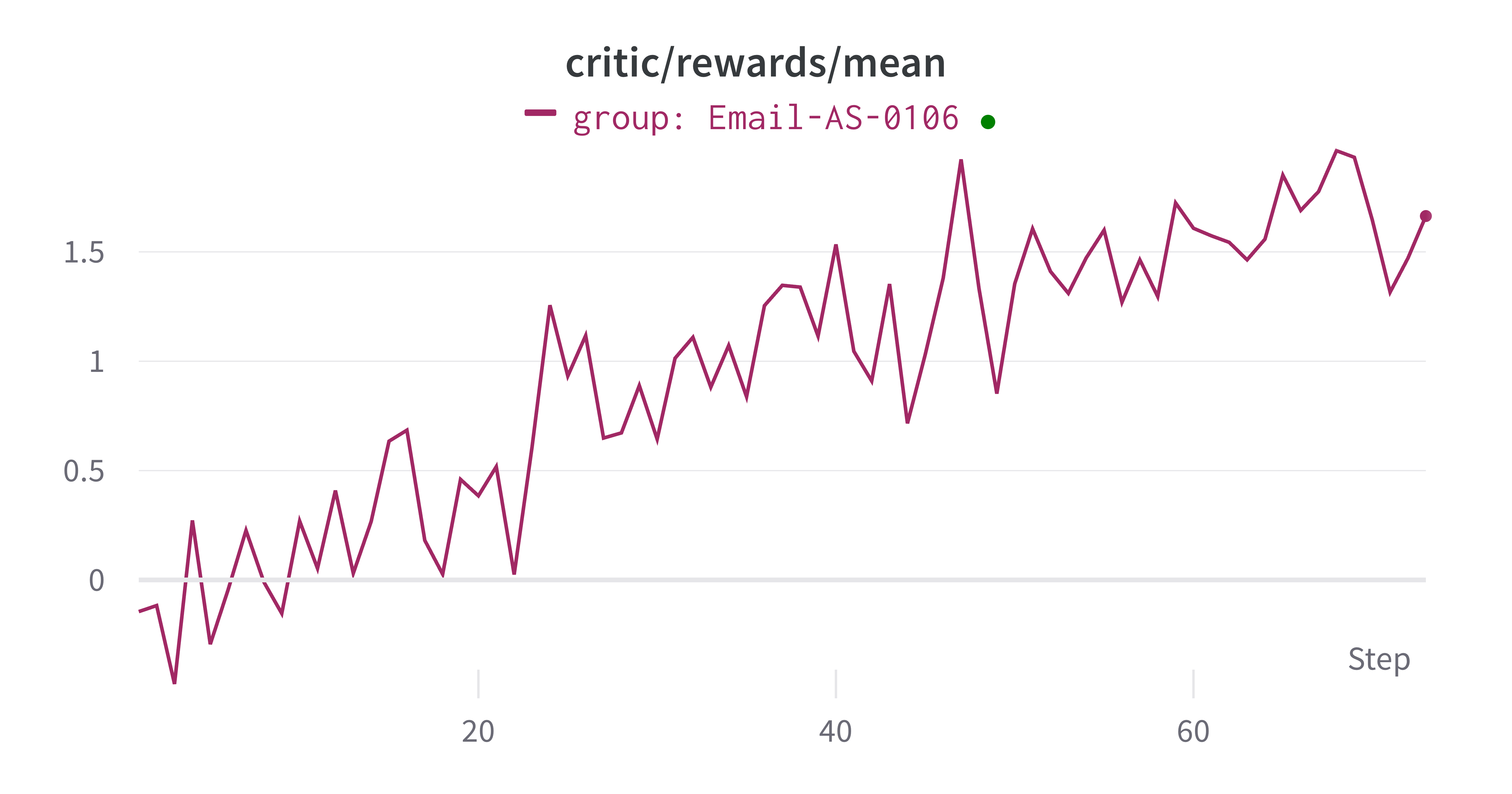
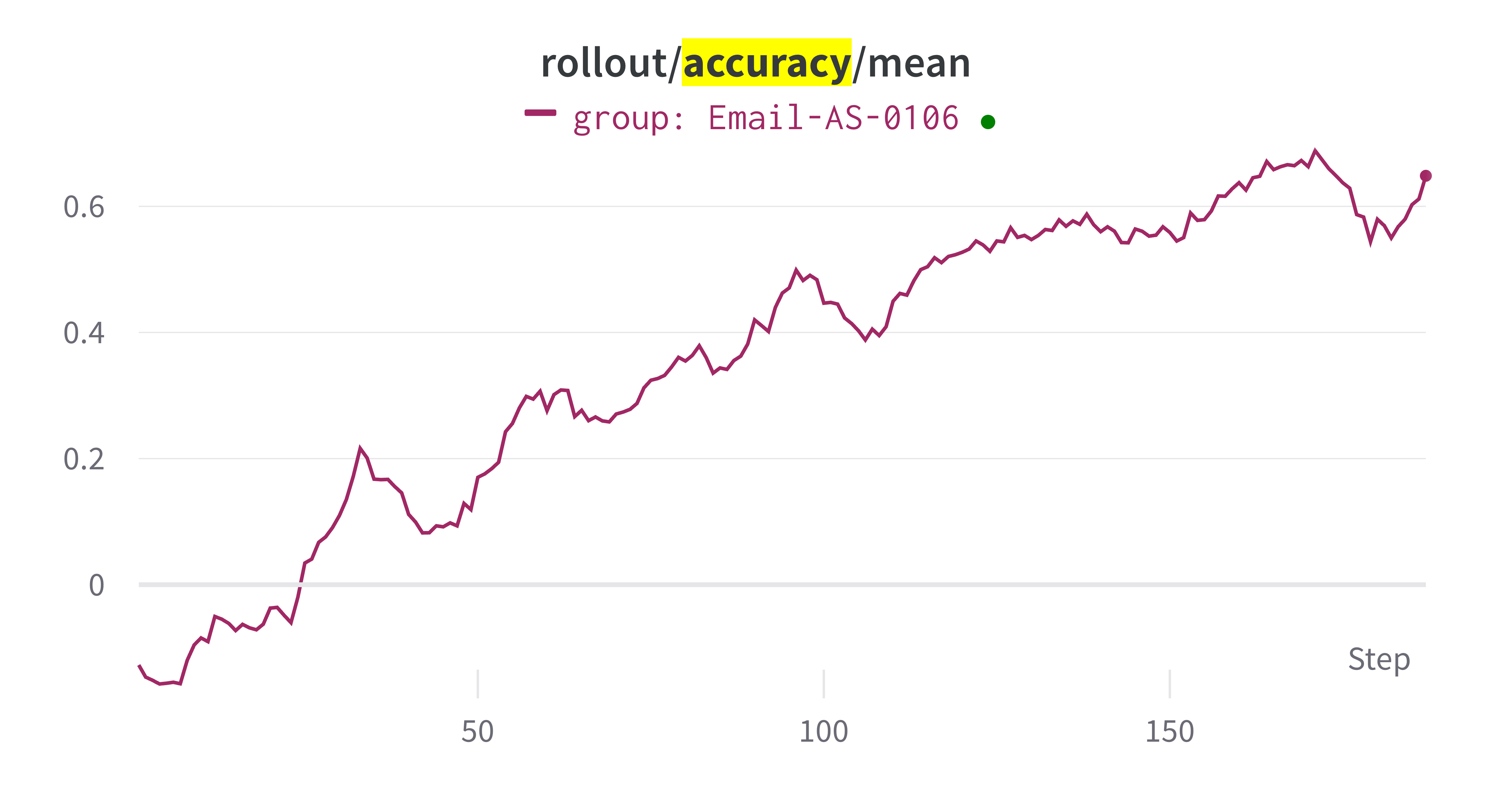
训练结果显示智能体性能随训练迭代次数的提升。关键指标包括:
- **训练奖励**:训练样本上的平均奖励随着智能体学习更好的策略而增加
- **Rollout 准确度**:Rollout 样本上的平均准确度随着智能体学习更好的策略而增加
### 具体示例
智能体行为示例如下:
**查询:** "What do the color codes mean in the curve assessment?"
我们展示智能体响应的最后几轮:
智能体执行多次搜索尝试以找到相关邮件。经过一些不成功的搜索后,智能体尝试:
**工具调用:**
```json
{
"type": "tool_use",
"name": "search_emails",
"input": {
"inbox_address": "steven.kean@enron.com",
"query_date": "2001-04-03",
"keywords": ["curve", "assessment"]
}
}
```
**工具结果:**
```json
{
"type": "tool_result",
"name": "search_emails",
"output": [
{
"message_id": "<2654330.1075846153519.JavaMail.evans@thyme>",
"snippet": "... curves and Senior Management as necessary.\\n\\nCurve Assessment\\n Green: \\n - curve is reasonable\\n - small P&L ..."
},
{
"message_id": "<12499967.1075846153495.JavaMail.evans@thyme>",
"snippet": "... curves and Senior Management as necessary.\\n\\nCurve Assessment\\n Green: \\n - curve is reasonable\\n - small P&L ..."
}
]
}
```
找到相关邮件后,智能体使用 `read_email` 工具读取两封邮件的完整内容:
**工具调用:**
```json
{
"type": "tool_use",
"name": "read_email",
"input": {
"message_id": "<2654330.1075846153519.JavaMail.evans@thyme>"
}
}
```
**工具调用:**
```json
{
"type": "tool_use",
"name": "read_email",
"input": {
"message_id": "<12499967.1075846153495.JavaMail.evans@thyme>"
}
}
```
阅读邮件后,智能体生成最终的结构化响应:
**工具调用:**
```json
{
"type": "tool_use",
"name": "generate_response",
"input": {
"answer": "In the curve assessment, the color codes are used as follows:\n- Green: The curve is considered reasonable, and the P&L (profit and loss) is small.",
"sources": [
"<2654330.1075846153519.JavaMail.evans@thyme>",
"<12499967.1075846153495.JavaMail.evans@thyme>"
]
}
}
```
评判器评估上面的答案为正确。